


Most interpretations I have heard or read about the transfiguration of Jesus in the parallel passages in Matthew 17:1-9, Mark 9:2-9, and Luke 9:28-36 revolve around the language of “glory,” “divine radiance,” “splendour,” and “resurrection foreshadowing.”
What I have read little about is the necessity of descent from the mountain and the abrupt plunge into the chaos of humanity’s everyday life. It is generally thought that Jesus was initially part of a sect of Jewish separatists who sought God through dissociation with the rest of the world, only to reject that pathway to life as God’s Son. Many believe that John the Baptist was also part of such a group—he lived in the wilderness, dressed in animal skins and scavenged for food (Mt 3:1-5). The evidence for a Jewish sect of this type in the era of Jesus is apparent in the incredible find of the Dead Sea Scrolls. In addition to the scrolls of the sacred texts of the Hebrew Bible, details of the community’s strict asceticism were uncovered. These were people who believed it was impossible to live as God’s people within the “hopelessly corrupt” Roman Empire.
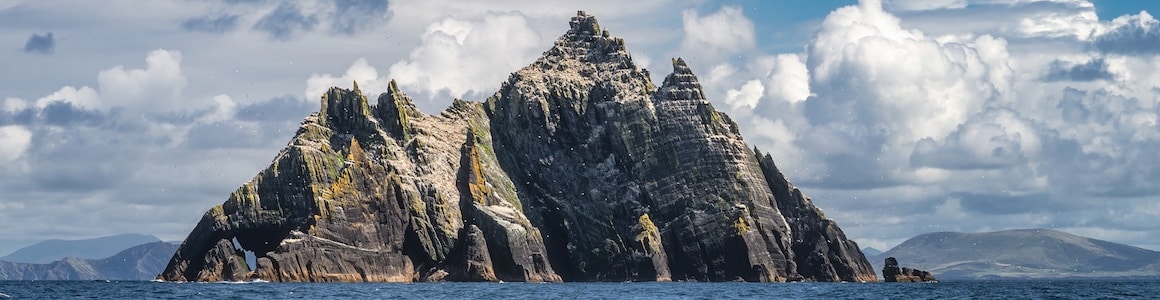
That same perception, of the corrupt world from which the people of God must withdraw, has driven religious communities for centuries to live segregated existences in search of communion with God. I visited one such place, Skellig Michael, the largest of two Skellig islands, eight miles off the west coast of Ireland. As early as the 6th century CE, monks came to form a monastery, building beehive huts out of stone near the very top of the 718 feet above the sea from which the island emerges. As a visitor, I arrived with six others on a small speedboat that brought us to dock at the base of the island mountain. There were rough stone pathways, each leading upwards. The walk was steep, and several people stopped about halfway up, where a couple of stone benches were fashioned. The view was spectacular from there, but we could just begin to see the huts that still stood near the peak of the island. It was an arduous and mostly desolate climb, save for the beautiful blue of the ocean all around. Once we reached the huts, abandoned since the 13th century, we could duck inside and marvel at their fortitude over the centuries and through countless storms.
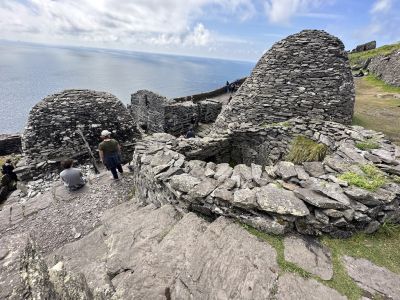
I was reminded that the disciple Peter reacted to the transfiguration of Jesus with a suggestion to build huts on the mountain for Jesus, Moses and Elijah, a notion quickly dispelled by a voice from the cloud (Mk 9:2-8). But, unlike Peter, these monks on Skelling Michael were successful. They built the huts on the mountaintop, and they dwelt there, 700 feet above and 8 miles away from the rest of the world. But after exploring the monks’ huts, we began to ask questions—how did they exist within that stony environment? The scarcity of soil disallowed most traditional crops and livestock. The monks, we learned, had to descend, most every day, to fish, to gather fresh water from the few streams that occasionally flowed down the steep slopes, and to trade their meagre goods with passing ships for grain. So, despite their dogged efforts to avoid the world, descent to engage with it was required even by the monks on Skellig Michael.
If we are watchful, most of us have a few moments of epiphany in our lives. These moments jar us out of the usual repetitive and uninspired motions that are required for our sustenance. An incredible amount of our lives is spent on feeding, cleaning and caring for our bodies. The ancient philosophers recognized this reality, and some groups encouraged their followers to eschew as many of the trappings of physical existence as possible, so that they might focus more on the true reality beyond what is readily seen, touched, and smelled. Plato’s “Allegory of the Cave,” in Book VII of The Republic, which Christian theologians often invoke, epitomizes the point of the grayness of life that does not recognize the richness of existence beyond what is experienced by the senses. Occasionally, something happens that allows us to glimpse beyond ordinary sight. The Greek word for this is apokalyptō, often translated as “revelation” but literally meaning “uncovering.” The image that comes to mind is that of a curtain being drawn back, only briefly, to expose an entirely unknownview. That quick look behind the curtain changes a person and calls them to reconceive what they had formerly imagined or left unimagined.
The transfiguration is one of those epiphanic moments, and as we read from the gospels, it was meant to be brief and to shake the participants’ perceptions of reality. The point of “seeing beyond” was to descend and to live within the chaotic world, but with the new eyes of one who knows that there is more to life than what is readily seen and heard and touched. The Greek word that gets translated as “transfiguration” is metamorphaomai, from which the English noun metamorphosis comes. We generally focus upon the dramatic change of appearance that happens to Jesus in front of the disciples’ eyes—gleaming white clothing, shining face as bright as the sun, all within a dazzling light—but the metamorphosis should also occur within the fortunate few who are a party to this look behind the curtain. They should be forever changed from this point on, even as they descend the mountain into the mire and messiness of life.
Dr. Lee Johnson
January 2026