

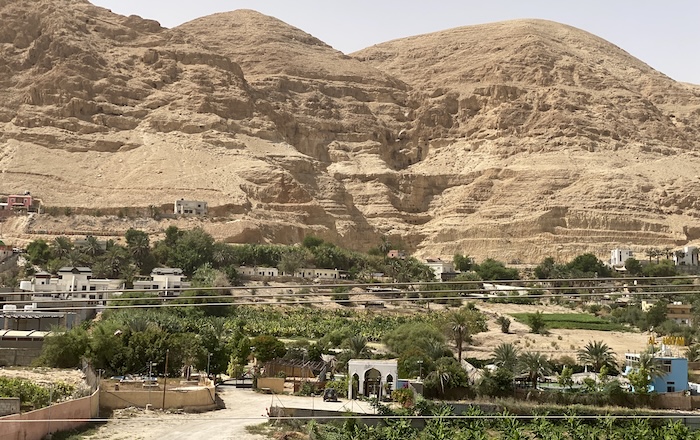
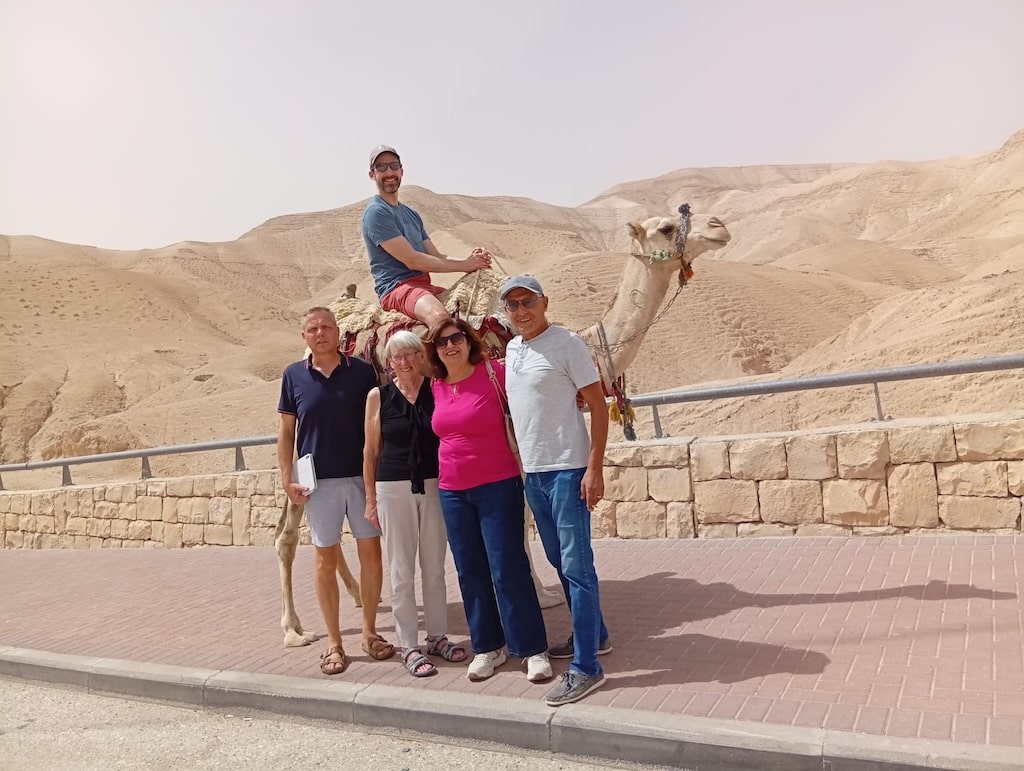
On one of the days during our visit to Israel and Palestine, we followed the way of Jesus by going to the Jordan River, where Jesus was baptized by John. Then we were led by our guide, Yusef, into the wilderness to the Mount of Temptation, where Jesus fasted and was tempted for forty days. Full disclosure, we did not do as Jesus did on that day. Instead of fasting and resisting temptation, we made our way to Temptation Gallery to pick up some Jericho dates and enjoyed dates dipped in chocolate. And we relaxed by a clean pool rather than going for a dip in the muddy, smelly waters of the Jordan River. While it was a day off for sightseeing, camel rides, and sweets…the check points, “Area A” gates, landmine field, torn up and blocked roads, and the barricaded King Hussein Bridge Border Crossing were all reminders of Israel’s control of Palestinian territory that provided yet another day for further reflection of a history and situation that is as murky as the Jordan River.
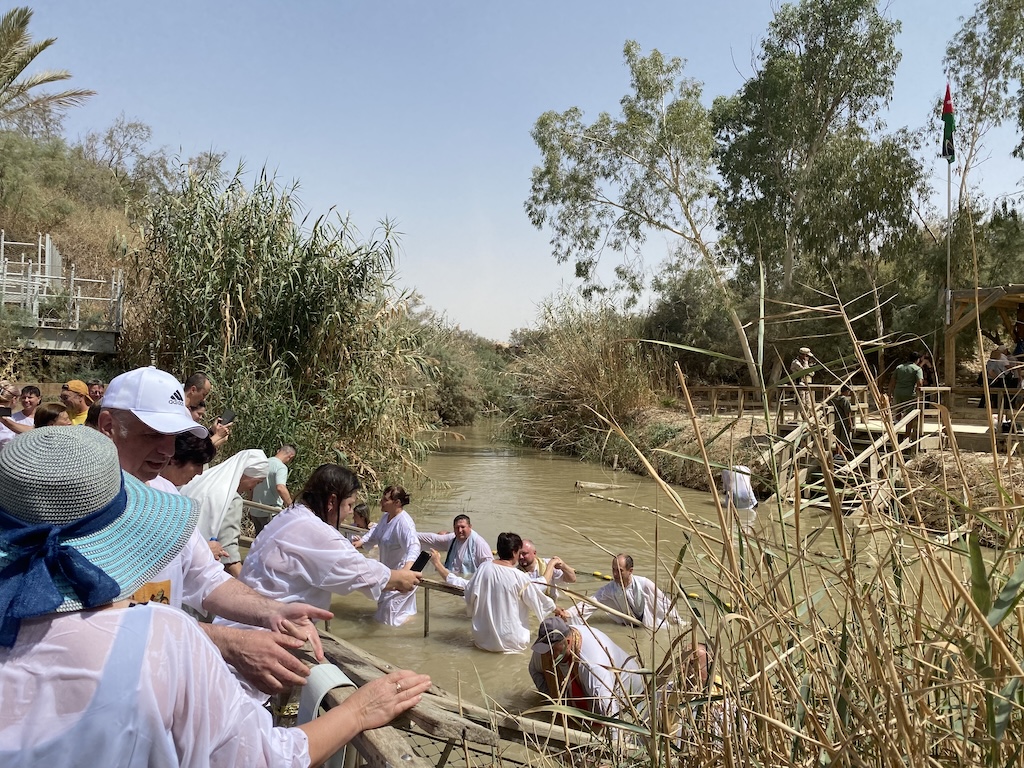
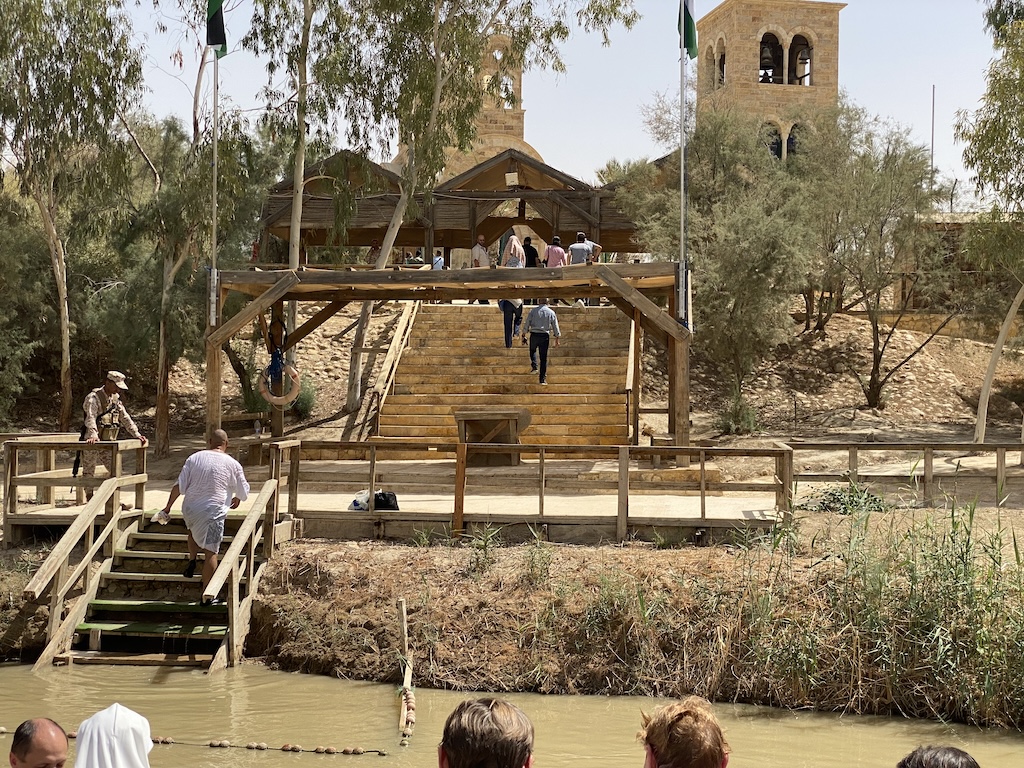
At the baptismal site on the Jordan River, it is very clear that the river marks a boundary between two sides. Two countries. Jordan and Israel/Palestine. We are in the West Bank, Palestine, but the Baptismal site is under the control of the Israeli state. So, the Israeli and Jordanian flags, the boundary marked by pool buoys, and the Jordanian armed soldier make it clear there are two distinct sides here. But in between this clarity are the unclear waters of the Jordan.
In the ongoing conflict of Israel with Palestine, the trauma of the Holocaust and the October 7 attack are brought to our attention. Yet, in between, is a long and violent history: the 1947 United Nations partition, the 1948 Nakba (meaning “catastrophe”), the Six-Day War of ’67, the Yom Kippur War in 1973, the first and second Intifada, the Oslo Accords, the Passover Massacre, the building the wall, the 2008 Israel attack on Gaza, several other attempts at peace, and countless acts of violence.
What grabs our attention in the news are the acts of extremists, those of Hamas attacking Israelis, the anti-Jewish terrorist attack at Bondi Beach, Australia, the daily anti-Palestinian settler attacks, which members of Rabbis for Human Rights have described as “Jewish terrorism”. Caught in between are the Muslims, Jews, and Christians navigating daily life, longing for peace, grappling with loss and grief, while in the West, we debate terms, history, or how to describe the situation on social media.
Reality does not give us two clear sides, Israel versus Palestine, as though equal participants in a war. Jewish American author, Sarah Schulman, writing about Palestine and Israel after October 7 in her book, The Fantasy and Necessity of Solidarity, comments on the use of “nonsensical, meaningless phrases like ‘two sides’ and ‘both sides’ as if they were functional concepts.”
Reality is often complex, multi-faceted, and unclear, like the river Jordan. Yet Jesus did not get baptised by John in a clear pool of water. He was baptised among us in the murky reality of our world and then set his face towards the conflicted city of Jerusalem. Jesus enters the unclear liminal space to be among us in between the political and religious violent extremes to reveal another non-violent way.