A growing project is a local initiative, with an impact that goes beyond the individual community. Across Canada, growing projects are bringing people together to support those in need around the world.
Growing projects encourage groups of farmers and farm supporters to plant, tend and harvest a crop, sell it on the Canadian market, and then donate the proceeds towards work to end hunger through Canadian Foodgrains Bank and its members. Many farmers donate a portion of their field, but another significant donation is the use of equipment, and precious time during harvest season.
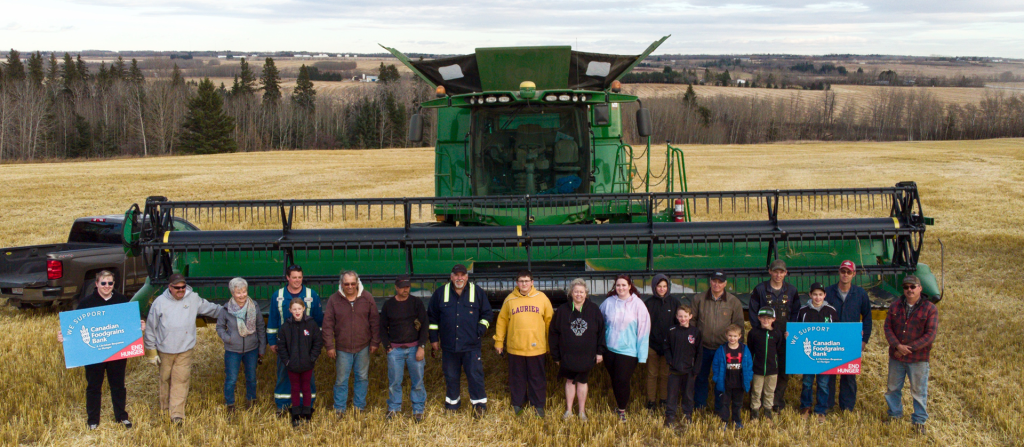
“For a small community, in a rural area, this is a way that we can make a difference,” shares Rev. Sandra Law, the minister at St. Paul’s Presbyterian Church in Eckville, Alberta. Since its founding in 1983, the St. Paul’s Presbyterian Church & Community Growing Project has been successful—sending in over $370,000 in the last 10 years alone to support those in need. “When we can put in a field of crop, and send in a pretty hefty amount, it makes it feel like we’re part of the bigger church.”
Even those who are not farmers get involved: “I contribute by feeding the farmers and running information sessions to make sure that both the congregants of Eckville and the broader community understand what we’re doing,” comments Sandra’s daughter, Abigail.
Despite worries about things like money to fund the project or what the weather will be like each year—sometimes growing projects are harvested in snow—Sandra reflects, “the triumphs outweigh the struggles completely. At the end of the day, everybody rises above to get the work done. You stand there really proud in the field and think ‘this is a wow moment’.”
The dream for the growing project in Eckville is that it would be able to expand. “People sometimes put us on their mission for a year, and that’s it.” Not only would consistent funding commitments help with this dream of growth, but there is also a practical need: “We actually need people to help,” says son Seth, the project’s photographer.
The Presbyterian Church’s involvement with the Grow Hope project in Saskatchewan and the Danforth Grow Hope project in Toronto are the first examples of a new trend.. Jo Szostak from Saskatchewan reflects, “At the Synod meeting in October 2022, when Guy talked about Grow Hope, it lit a spark in me. I was astonished at the 828 million people who are hungry in the world, and it was important to be able to participate in addressing the world hunger crisis.”
Jo’s curiosity led to the Synod of Saskatchewan getting involved in a Grow Hope project that had previously had only Mennonite, Roman Catholic and Baptist involvement. Jo now organizes the Synod’s involvement in the initiative.
Grow Hope projects aim to build bridges between urban and rural communities, offering opportunities for urban churches to donate funds to support rural growing projects. Jo explains, “There are a number of different types of growing projects but this one is unique in that it involves both rural and urban folks working together.”
Reflecting on the government matching available through Canadian Foodgrains Bank that allows funds raised to go over further, Jo exudes “it is really exciting to be part of an initiative that can have such a significant impact.”
Jo is already looking forward to the next harvest, which she expects will surpass that of 2023, when they raised over $12,000. “So far in 2024, the Synod has received over $6,000 to assist farmers with inputs – that’s enough to fund more than 17 acres of crop.”
Just like her peers in the Eckville project, Jo would like to see more people—specifically Presbyterians—involved. “We haven’t yet received a donation of acres from farmers through the Presbyterian church, so that’s definitely a challenge. We have shared in the acres donated through other denominations. We are young yet, and as we grow, I hope it will become possible to involve farmers in the southern part of the province as well.”
“It is indeed heartwarming to know that we can help ease the hunger of those in the world who have very little food to eat.”
To learn how your congregation can get involved in a growing or Grow Hope project, contact us at [email protected].
*This story was first printed in the Fall 2024 issue of Presbyterian Connection newspaper.