One of the devastating effects of conflict is how it destabilizes people’s lives even after the fighting has died down. After the peace agreement between the Tigray fighting force and Ethiopia’s federal government, communities who had been affected by the war had relief from hearing the sounds of heavy weapons. However, the impact of the conflict remains severe for many families trying to rebuild their lives.
Ato, a farmer from Tigray who, along with his family of ten, lost his household assets due to the war, reflects: “There was no way to start my usual means of earning a living – farming – because I had no money to buy seeds and tools.” The conflict set off a difficult two years for Ato and his family. Food was sparse – his family would eat once a day. They did not have diverse food for a balanced diet.
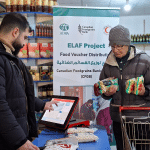
Ato’s family is one of 323 households who participated in a PWS&D-supported agriculture and livelihoods program in Tigray through partner Tearfund. He received seeds and goats as well as hand tools.
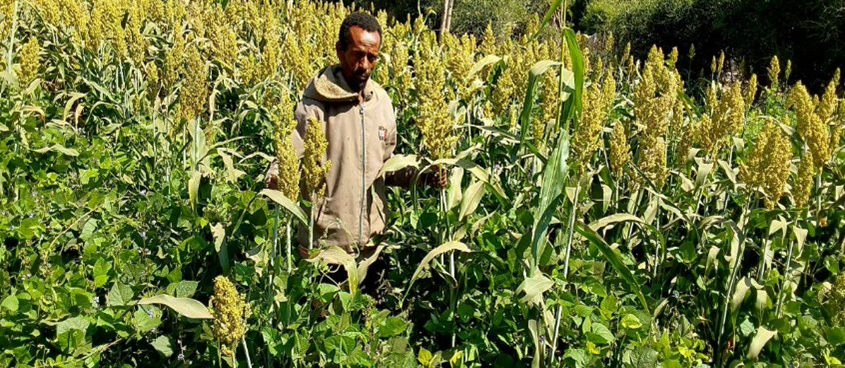
Equipped with these supplies, Ato was able to resume his work. Now he is growing healthier food for his household, with nutrient-rich teff and sorghum among the seeds provided. Additionally, since learning about conservation agriculture, his crop yields have increased for more consistent food.
“Conservation agriculture is new to me. It had seemed impossible when it was first introduced by the project because there was no such practice in the area. However, through a series of trainings on conservation agriculture principles, my mind was changed to adopt the practice on my own plot.”
Ato used a trial 20-metre plot to plant sorghum, which he covered with plant residues and grasses. He also planted a cover crop seed called Labla. During the dry season, he noticed that all his other crops dried out, but the plot using conservation agriculture remained green and productive. He found the conservation agriculture approach very useful because it saves time and energy while also treating the health of the soil. Ato reflects, “I expect a better harvest from this small plot than the other wider uncontrolled plots I have. I will expand and apply conservation agriculture to the rest of my plots.”
The impact of this project reaches beyond Ato. The family received two goats from the project, which are under the care of his wife. These goats produced four kids, one of which the family sold to cover financial gaps.
In addition to rearing their livestock, his wife is a member of a self-help group in the community. She participates in a weekly savings group. Ato adds, “My wife will get a loan in the near future, and she will engage in simple businesses.”
“I am very happy with the impacts of the project on my and my family’s lives, and grateful to the supporting and implementing partners.”
*This project is receiving support through Canadian Foodgrains Bank. PWS&D is a member of the Foodgrains Bank, a partnership of 15 churches and church agencies working together to end global hunger.