Marvin Parvez is the regional director of Community World Service Asia, PWS&D’s partner in Pakistan and Afghanistan. This spring, we sat down with him to discuss the work the organization is carrying out with PWS&D’s support to help people in marginalized communities have better health, food security and livelihood opportunities.
Could you tell us a bit about yourself, Marvin, and about the work that you do at Community World Service Asia?
I’m originally from the southern part of Pakistan, Karachi. And I’ve been in this line of work serving communities for almost for 35 years. I’ve done this in Central Asia, South Asia and Southeast Asia.
CWSA is a very diverse organization. We work on humanitarian programs, development and – very important, very essential, if you’re doing this – advocacy.
I do take pride in the fact that we are a woman-led organization. And I celebrate this every time I say that I am the last man to lead this organization. I think we are today very innovative, very transparent, very accountable, and very good because of the women leadership in our organization. And that’s amazing.
We work with partners. That keeps our work engaged with other civil societies. It keeps the operational costs low, and it develops a bigger network of like-minded organizations.
Always, I think the work we do together in that part of the world [Central Asia, South Asia and Southeast Asia] is possible because of the support we get from congregations, communities and individuals. You know, people giving five dollars here and five dollars there. That’s what makes us truly such a community-based organization: it’s communities helping here so that we can serve communities in different parts of the world, in our case [Central Asia], South Asia and Southeast Asia.
Do you have an example of someone who has participated in the programming that CWSA is doing? What were they facing, and what does their life look like now?
There is a feeding program in schools that we run in Pakistan. I call it the happy program, because it’s such a good meal. They’re getting education, and they get a really decent nutritious meal. I wish I could explain how great the impact of something as simple as a good meal is for these kids, and how it changes their life, their attitudes and leads to a better future: when they have been able to do well in school, they can have a better livelihood later, to provide more food. (You can read more about this PWS&D supported project by clicking here.)
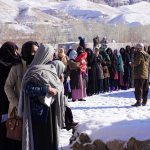
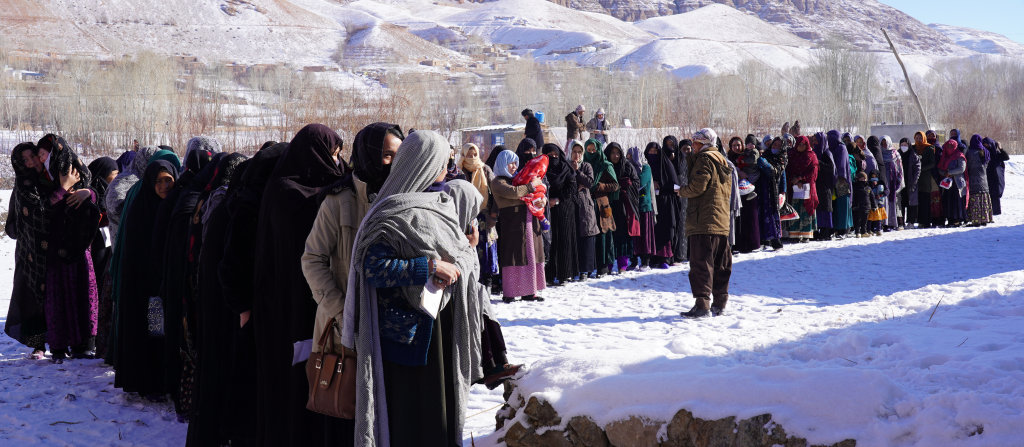
Let me also talk about the work that PWS&D and CWSA have done jointly in Bamyan, central Afghanistan. There is a mountain range that has a lot of caves and gets very cold. It gets cold like Canada, and people can’t afford heating. They don’t have money for fuel or wood to burn, or for food, or other shelter and housing outside of a tent or a very weak structure, so they move to these caves during winters. (You can read more about this project here.)
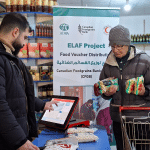
It’s really like traveling back in time. The rations we jointly provide, the shelter, the heating: these things are lifesaving. With temperatures of minus 30 degrees Celsius at night, children and elderly people die. So, it’s lifesaving.
A lot of times you think, “Oh, this is just food.” No, this is food. This is heating. This is shelter. Essentials that keep people alive. I need to highlight this because even in this very broken world, jointly both faith-based ecumenical and secular organizations are still saving millions of lives and making sure hundreds and thousands of families have decent work. And so, they are still achieving a lot and serving a lot of people in need.
Why is it important to work with local partners in your context?
In this context, we are the local partners: 99.9% of our 350-person team are Afghans and Pakistanis. But again, 51% are women, all from very diverse backgrounds.
They are from the community. They know what’s culturally sensitive, what the challenges are.
Historically, ecumenical church-based organizations have stayed very committed to communities. When the Russians left Afghanistan, everybody left, but the church-based organizations continued their work and still do. That is a long-haul commitment.
For example, the three of us sitting here together all have different gifts, and we are stronger together. So, I think that kind of partnership between a group in any country [and a local organization], in this case, PWS&D and CWSA, is the best combination to serve the people.
What would you say is the biggest challenge the communities you work with are facing right now?
I think communities [in Canada] are still very generous and very supportive. People have very passionate, loving, caring hearts. I think that has not changed, but what has changed is that in the driving seat we find media and politicians when it comes to determining where the aid goes: whether it goes to Sudan or it goes to Yemen or Burma or Ukraine. Also, there’s a shift of culture that makes us feel vulnerable and unprotected.
When you show less solidarity and generosity to people in need, there’ll be more hunger. Where I come from, there’ll be more illiteracy, there’ll be more sickness. People will be unhealthy, both physically and mentally. There’ll be more war. So, the need is going to increase and people will become desperate, and when they’re desperate, they’ll take desperate measures. They’ll continue to get in boats and pay human traffickers and try to come to somewhere where their family can be saved, their daughter can go to school, and their elderly parents or wife can get medical help. So, I think that some of the values that have been trusted in are not solutions, they’re going to increase the global problems. And I think that that would increase our workload, quadrupling it.
And so, I think with the [Canadian] government’s changing policies in their overseas development and humanitarian program, it means more communities have to be more generous. But not only generous – I think there’s a huge advocacy thing also, because they need to write to their MPs or their local premiers and say that we have to do more.
Canada, when it comes to being generous, is a role model. Take, for example, the whole program at the Canadian Foodgrains Bank: the government chips in, the farmers and communities and congregations chip in. So that kind of partnership needs to expand and needs to be replicated in all of North America.
What gives you hope right now?
Being in the field gives me hope. Even if the numbers are small compared to the kind of misery, need, war and hunger that is going on, we helped 12,000 families this last winter in central Afghanistan. This gives me hope.
People are still very caring, very generous, and they want to help everybody. Farmers in Canada don’t even know Ahmad or Parveen or this little girl in Central Highlands or in the most remote northern areas in Pakistan, but they care. That gives me hope.
We find allies in the most difficult areas. We have allies when we work in Burma together, we have allies in Sri Lanka, everywhere. In every stakeholder, government, provincial district. Because, in the end, everybody has kids, everybody has families. We find allies and supporters in some of the strangest places where we implement programs, and that gives me hope.
Learn more about the work of Community World Service Asia by watching Seeta’s story, and give to support the work today.