


On this day,
Jesus gathered with his disciples in an upper room.
On this day,
Jesus knelt to wash his disciples’ feet,
and he gave a new commandment,
that we love one another as he loves us.
On this day,
Jesus took bread and wine,
blessed them and gave them,
commanding us to celebrate this holy feast
in remembrance of him.
Maundy Thursday, or Holy Thursday, commemorates two significant events that took place on the night of Jesus’ arrest. The first event is recorded exclusively in the Gospel of John and recounts when Jesus washed the disciples’ feet and said, “A new commandment I give to you, that you love one another: as I have loved you, that you also love one another.” In Latin, the saying is: ”Mandatum novum do vobis ut diligatis invicem sicut dilexi vos ut et vos diligatis invicem.” Jesus’ opening word mandatum, translated as “commandment,” is the source of the word Maundy.
The second event observed on Maundy Thursday is the institution of the Lord’s Supper. Surprisingly, the oldest written record we have of the first celebration of the sacrament which we often call Holy Communion comes not from the Gospels but from Paul’s first letter to the Corinthians. Approximately 25 years after the Last Supper, Paul writes:
For I received from the Lord what I also handed on to you, that the Lord Jesus on the night when he was betrayed took a loaf of bread, and when he had given thanks, he broke it and said, ‘This is my body that is for you. Do this in remembrance of me.’ In the same way he took the cup also, after supper, saying, ‘This cup is the new covenant in my blood. Do this, as often as you drink it, in remembrance of me.’ For as often as you eat this bread and drink the cup, you proclaim the Lord’s death until he comes (1 Corinthians 11:23-26).
The Lord’s Supper deepens our union with Christ and with each other. In the sacrament, Christ’s presence in his world and church is a symbol of hope for a troubled age. In the seemingly simple act of eating at Christ’s table, we receive signs of his love and we anticipate the joyful feast we shall have in the coming kingdom.
In addition to the spiritual comfort and sacred meaning of the sacrament received in the Lord’s Supper, the rite inaugurates a symbolic social event that is too often overlooked. Most of the population in Jesus’ day led an existence dominated by hunger. Each account of the first celebration of the Lord’s Supper describes the rite taking place during a meal shared by Jesus with his disciples. The context in which Paul recites the words that Jesus spoke during the Last Supper is an exhortation to ensure that all received sustenance and that at least for that moment, the ever-present hunger of some subsided.
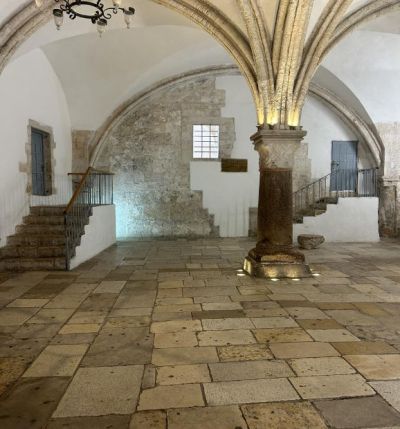
Image from the proported site of the original Lord’s Supper, Jerusalem
The meal gathering promoted an egalitarian vision, including Jesus assuming the role of a slave, in order to encourage his disciples to reject the rigid Roman dining custom where one’s place around or adjacent to the table reflected one’s societal status. The early church’s celebrations of Holy Communion wherein they remembered Christ and his ministry was a counter-cultural act of subversion. The fledgling communities did not mirror the divisions in the world around them; rather in the act of sitting down together around a table and sharing bread and wine transcended and eliminated the economic and divisions of the status quo.
The theologian Daniel L. Migliore challenges participants in the Lord’s Supper to remember the social implications of the sacrament:
Christians cannot eat and drink at this table — where all are welcome and none goes hungry or thirsty — and continue to condone any form of discrimination or any social or economic policy that results in hunger or other forms of deprivation (Faith Seeking Understanding: An Introduction to Christian Theology, 225).
We cannot gather around Christ’s table on Maundy Thursday, where all are welcome, and be satisfied with any form of discrimination or exclusion that prohibits others from making full claims on life. We must not freely receive the living bread, like the freed slaves from Egypt received manna from heaven, without persisting in our efforts towards the liberation of those who are enslaved by any power that stifles life. Our mandatum is to “take,” “eat,” “drink” and “proclaim;” the grace given is not complete until it is shared.
Ian Ross-McDonald
Maundy Thursday 2026
You can download a PDF of the reflection on the Worship webpage on the top right under “Reflections on Themes of the Liturgical Year”.